Who Owns a Tree on the Property Line in Ontario?
If the trunk grows across the line, the tree belongs to you and your neighbour together. Here is what that means before anyone cuts.
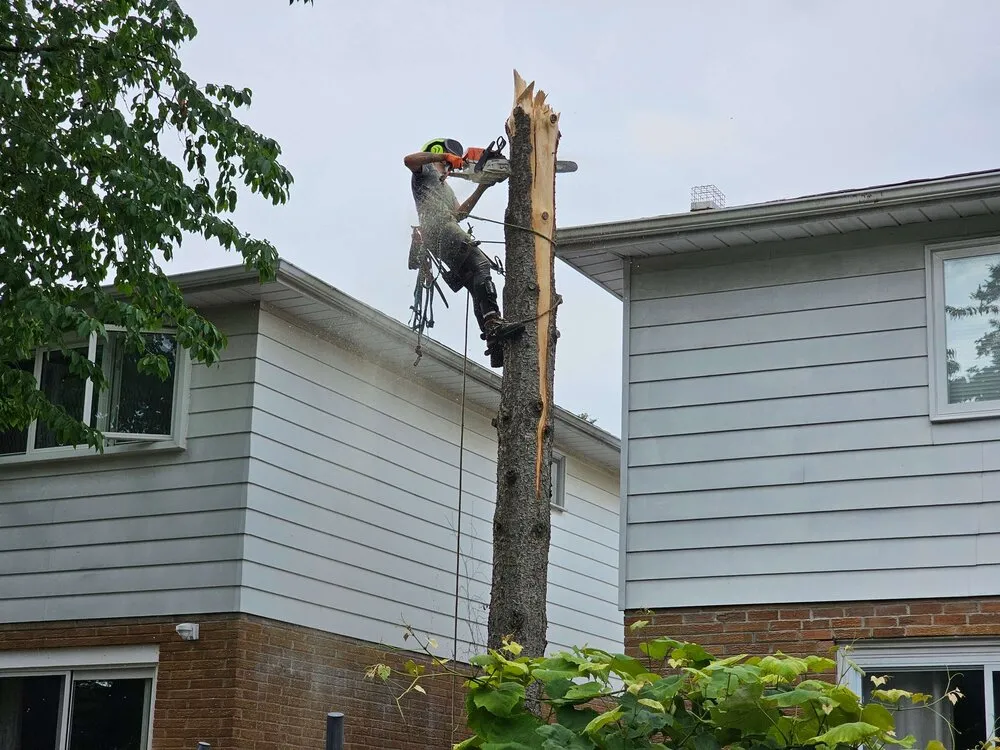
In Ontario, a tree whose trunk grows across the property line belongs to both neighbours. Section 10 of the Forestry Act makes it common property, and injuring or destroying it without the other owner’s consent is an offence. If the trunk sits entirely on one side, the tree belongs to that owner, even if the branches and roots reach next door.
What Counts as a Boundary Tree
The test is the trunk at ground level. If any part of the trunk crosses the line, it’s a boundary tree. Branches hanging over the fence don’t make it shared, and neither do roots under your lawn. A tree planted a metre inside your neighbour’s yard is theirs, however much of it shades your side.
On older Woodbridge and Thornhill lots, a lot of mature maples and spruces were planted along the fence line decades ago. As the trunks grew wider, many of them crossed the line.
Find the Line First
Your property survey shows the line. Fences are often built a little to one side of it, so the fence alone doesn’t tell you who owns the tree. If you can’t find your survey, look in the papers from your purchase or ask the lawyer who handled it. If the stakes in the ground are gone, an Ontario land surveyor can mark the line for you.
Removing a Shared Tree
You need your neighbour’s consent to remove a boundary tree, or to cut it in a way that would seriously damage it. Get that consent in writing before any work starts. A short note signed by both of you, naming the tree and the work, saves arguments later.
You also need a City of Vaughan permit if the tree is 20 cm or wider, the same as any private tree. The City expects every owner’s consent on a shared tree. Read the Vaughan permit rules for how that works.
Roots Across the Line
Roots from a tree next door often grow under your lawn, patio or driveway. Cutting large roots can kill a tree or make it unstable, and that counts as damaging it. If roots are lifting your interlock or pushing on a wall, talk to your neighbour and get advice before anyone cuts. A root that injures a protected tree can also bring the Vaughan permit rules into play.
Sharing the Cost
The Forestry Act doesn’t decide who pays. Most neighbours split the cost of removing a shared tree. When we quote a tree removal on a boundary tree, we’re happy to walk the yard with both of you, so everyone hears the same plan and the same price.
Trimming a Shared Tree
Light trimming that keeps a shared tree healthy is less of an issue than removal, but it’s still wise to agree on it first. Heavy cutting that injures the tree needs your neighbour’s consent, and a Vaughan permit if the tree is 20 cm or wider.
When You Can’t Agree
If your neighbour won’t agree, you can’t remove the tree. Start with a conversation about what worries you, whether it’s the lean, dead limbs or roots lifting the patio. Sometimes a trim fixes the problem and nobody needs to lose the tree. If the tree is a real hazard, an arborist’s written opinion gives you both something solid to look at. Past that point, talk to a lawyer before anyone cuts.
A Tree That Is Only Yours
If the trunk is fully on your side, the tree is yours to look after, and the permit rules still apply. Your neighbour may trim branches that hang over their side, back to the line, as long as they don’t kill or seriously damage the tree. If a tree on your side is dead or dropping limbs into the yard next door, have it looked at before a limb lands in their yard.
Customer Reviews
-
Best prices and [they do] the job super clean. It's almost like they were never there. Great communication and answers any questions you may have as well. Highly recommended.
Koby, customer review
-
[The team was] professional and safe in removal of dead trees and limbs on my property. Stacked and cut the wood neatly for easy removal. I'll be calling them for my future needs.
Sergio, customer review
Boundary Tree Questions
How do I know where the property line is?
Your survey shows it. If you don't have one, check the papers from your purchase. Fences aren't always on the line, so don't rely on the fence alone.
Who pays to remove a shared tree?
The law doesn't set a split. Most neighbours agree to share the cost. Get the agreement in writing before the work starts.
My neighbour refuses to let me remove a shared tree. What now?
You can't remove it without their consent. Talk it through, and if the tree is dangerous, get an arborist's opinion. If you still can't agree, speak to a lawyer.
Get Your Free Quote Today
Call, text a photo or send the form. We come out the same day, measure up and give you a firm price on the spot.
- Hours
- Mon to Sun, 8am to 8pm
- Address
- 10385 Weston Rd, Vaughan, ON L4H 3T4
Get directions - Where we work
- All of Vaughan, including Woodbridge, Maple, Kleinburg, Concord, Thornhill, Vellore Village, Sonoma Heights, Patterson.
Request a free quote
Quoted today. Booked fast. Cleaned up the same day.
Call (289) 444-0864